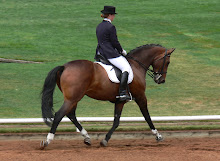
Last weekend I audited a clinic with one of the world's top dressage riders and trainers: Jan Brink from Sweden. The clinic was held at KGF Equestrian Center in Kirkland, Washington, and hosted by Steinberg-Bryant Dressage. One of Jan's big themes throughout the weekend was adjustability in the horses. Interestingly, he thought that 35 years ago the emphasis in dressage was on big, ground covering gaits, but he feels that now it is much more important to be able to vary the gaits smoothly and quickly. He further discussed what he called the three "control points":
1) The Track--the rider needs to be able to control the relative alignment of the horse's front legs and hind legs
2) The Rhythm--the rider needs to be able to speed up or slow down the horse's rhythm while maintaining the same stride length
3) The Strides--the rider needs to be able to ride longer strides or shorter strides while maintaining the same rhythm
Jan feels that riders should not wait too long to start varying the strides with young horses, even three and four year old horses. With the very young horse, riding longer and shorter strides has nothing to with collection but it is in the direction of collection. In fact, with the young horse it is helpful to think to ride longer strides, but then back to the normal stride as the young horse is not strong enough to really do shorter strides. He also had the riders ride a 20m circle in the canter with longer strides, then riding a smaller circle (15 or 12m) when riding coming back to the normal stride length which encourages the horse to come back.
Adjusting control point #2 is a little more confusing (at least for me!). Jan used the analogy of a basketball player dribbling a basketball. The ball can be dribbled quicker or slower without making it move more forward. This ability to change the rhythm but keep the stride length the same is very helpful when teaching flying changes, as the horses need to "bounce" more off the ground in a quicker beat to get the change. He had several of the riders just ride on a 20 meter circle, find a baseline rhythm in the canter for instance, and then practice just changing the rhythm to quicker or slower steps.
To really test control point #1, Jan had the riders ride often on the centerline. With the young horses it is enough just to try to ride straight down the centerline! On the older horses the riders could ride shoulder-in or travers on the center line to really test their ability to control the shoulders and haunches.
As the work became more advanced Jan would have the riders combining the three control points and emphasizing different elements, depending on the strengths and weaknesses of the horse and rider. For instance, in training the pirouettes, Jan would have the riders ride travers in the canter on a 15 meter circle. Within that movement, the riders were to quicken the horse's rhythm. When the riders had a good feeling, they could then change to riding a 12m circle, or 10m circle or down to a 6m circle, but always the rider needs to stay disciplined about the circle line. It was a good "bodybuilding" exercise and an excellent exercise to train the horse to balance and wait during the pirouette canter.
Jan was great at explaining both the more general issues, and then applying these general points to the individual horse/rider combination to help improve specific aspects of their performance. All in all, a very good clinic!
Tuesday, January 18, 2011

Sunday, December 12, 2010
Talented young dressage horse for sale!!

I recently updated my website with an impressive and talented dressage horse for sale. He is a 2006 Dutch warmblood gelding by Farrington out of a Welt Hit II/Jazz mare. He's over 17 hands, and with his huge scopy gaits and fantastic uphill canter, definitely a horse that will make the judges take notice!
Visit my website http://www.heather-oleson.com/ for more information and a video of this talented horse!
Sunday, December 5, 2010
Region 6 Youth Camp 2011!!
Mark your calendars for the 2011 Region 6 Youth Camp, to be held July 5th-8th (Tues-Fri) at DevonWood Equestrian Centre in Sherwood, Oregon. Last year almost 50 kids from all over our Region traveled to attend the first ever Youth Camp. Six local dressage professionals, all former participants at the NAJYRC, donated lessons and travel time to be a part of this unique opportunity. We also had lectures on various horse and dressage-related topics, including a demonstration on the FEI jog and a round-table discussion with all the instructors on their Jr/YR experiences. All proceeds from the camp went directly into the Region 6 Advanced Young Rider fund, which helps offset expenses for our Jr/YR team to travel to NAJYRC.
Last year's camp was an unbelievable experience, and everyone is excited for next year!! Stay tuned for more details!
Tentative 2011 Show Schedule
Hi all!
Hope the holidays are treating everyone well! The horses and students are all going very well, I've been very pleased with everyone's progress. The weather turned to winter rather quickly here in Boise, even before December 1st we had a snowstorm which dropped between 6-8 inches here in the valley!
But, it is never too soon to start thinking about next year. Here is my tentative 2011 show schedule:
March 31-April 3: Festival of the Horse CDI***, Burbank, CA
April 7-10: Golden State Dressage Festival CDI ***, Rancho Murieta, CA
April 23-24: Les Bois Spring Spectacular (schooling show), Eagle, ID
May 7-8: Idaho Dressage Festival, Nampa, ID
May 28-29: Spokane Spring Dressage Show, Spokane, WA
June 16-19: Golden State Dressage Classic CDI*, Rancho Murieta, CA (maybe??)
July 22-24: Dressage at DevonWood, Sherwood, OR
August 13-14: Boise River Dressage, Eagle, ID
September 22-15: USDF Region 6 Championships, Nampa, ID
This schedule is subject to change. My team is looking forward to a fantastically fun and exciting show year next year!! Now if we can just get through the winter...
Sunday, November 7, 2010
Conrad Schumacher clinic notes, Gig Harbor, WA
I just returned from a Conrad Schumacher clinic in Gig Harbor, WA. It was a super clinic, with some very interesting horse and rider combinations. Including several adult amateur riders on a variety of different horses, a few professionals on medium level horses, and a couple of eventers interested in furthering their dressage. I rode my horse Escorial (whom Conrad has seen for many years), who is now schooling all the GP work. Here are a few notes I took while watching the other riders:
Leg yield--think flexion and yielding towards outside leg so horse finds the outside leg. This is a good preparation for the canter departs, and helps to get the neck longer and looser.
Use counterflexion in canter as preparation for flying changes. Ride long sides in true canter with counterflexion then inside flexion through the corner and on short side...repeat a few times. (This really helped get my horse looser and longer in the neck in his changes)
The canter aid comes predominantly from the outside leg (interesting because some trainers think it comes mostly from the inside leg)
*Simple movements matter alot, because they help the horse to understand easier what we want* (This comment was made in regard to working on walk-halt-walk transitions with an older horse)
The rider must be relaxed in the shoulders--give the rein out of the shoulders--or, "give with contact" (Conrad often has riders "roll their shoulders" to get them looser there, he also wants the contact to become more elastic, which comes out of the shoulder, not the arm)
Square exercise with deep corners--start with trot-walk-trot transitions (trot to walk before corner, walk deep into corner, then trot out)--then move to riding square in trot with almost walk --"back, turn, give"--helps to get horse to come back on its own in the corners--same exercise can be done in canter with canter-walk-canter
Wednesday, September 22, 2010
Region 6 Championships wraps up a successful Show season!!
I will finally be heading home (to Boise) tomorrow after a short segue following the Region 6 Championships. My truck decided it needed some extra attention and an early Christmas present, and demanded all new fuel injectors. Now I have much more get-up-and-go!
The Regionals went very well for me and my team. Juniors Ashley Holmes and Paige Haas had several good rides in Second level. We are looking forward to lots of hard work over the fall to prepare for Juniors next year! Very exciting! Amateur rider Barb Sparks earned one third and two fourth places in her (very large) classes, including one qualifying score for First level for next year.
Charismatique had three very nice tests, scoring mid-60s at Third level. He was Reserve Champion in the NW Third level open and barely Third in the Great American Championships. My "catch-ride" for the weekend, Lauralei, had two very nice tests at Fourth level, scoring in the mid-60s both times. She was Reserve Champion in the NW Fourth level open and barely Third in the Great American Championships. Not bad considering I've only ridden her probably 10 times total since mid-May. Her owner has done a super job of keeping her going at home and improving her pirouettes. :)
Everyone handled the nasty, rainy Seattle weather very well. I was VERY impressed with Donida Farm's footing and their renovated facilities. The footing was absolutely solid, and with the exception of a few holes in the warm-up arena, extremely safe. That says alot, given the amount of rain we had.
Now is the time to relax and think about goals for next year. And they are BIG goals!! More to come later...
Sunday, August 29, 2010
Show Nerves
A topic near and dear to the hearts of all competitors!
The more I compete, the more I realize that the most difficult part of competition is being "mentally flexible", or able to ride the best test you can with what you have at that moment. It means being able to deal with show management issues, bad footing, timing problems, warming up with Olympic riders, bad warm-ups, and so on and so forth. It means doing your best with what you have, and not letting yourself get rattled and distracted by other issues.
This year alone I have had (1) to ride a third level test on a young horse 20 minutes after a CDI PSG test on a different horse, (2) to deal with a CDI awards ceremony taking place in the arena next to my test, complete with the Canadian national anthem blasting in the middle of my free walk and the subsequent galloping of awards horses, (3) to ride a CDI PSG after I made the stupid mistake of carrying my whip into the test, being called up to the judges stand at C and told to drop the whip and ride my test, (4) to both precede and follow current World Cup Champion Steffen Peters in several classes, and finally (4) ride 4th level test 3 on a fairly quirky and complicated mare whom I hadn't ridden in 2 months, after only a 15 minute warm up with NO flying changes (all because I forgot to check my ride times, and didn't see that show management had changed my time from 7:37 to 7:18am!!).
In every one of these situations, I remember thinking to myself, well, here's another good test of show nerves!! How well can I ride this test? How can I make the most of this circumstance? How good a performance can I generate from these circumstances?
Whether you ride in schooling shows or CDIs, you will always have to deal with some sort of unfortunate circumstance. My spooky Arabian taught me that the circumstance was unimportant (I swear he found things to spook at, and if they weren't there, he invented them!!), it was how the rider dealt with the situation that really mattered. Because there will always be another unfortunate paper blowing across the arena, another test runner taking their job too seriously, another windy, cold day when your horse would rather be leaping and cavorting in the air than obediently performing their dressage test.
Viewed from this light, the greater the negativity and problems you have to deal with, the greater your success. It is one thing to ride a 62 percent test with a good warm-up and when you are feeling well, and a whole 'nother thing to ride a 62 percent test when you only got 5 minutes warm-up because you feel like crap and your horse kicked you when you were tacking him up.
Subscribe to:
Posts (Atom)